
Three Questions
If one engineer can now cover product design, software development and part of testing with the help of AI, does the company still need the same fine-grained division of professional labour?
If one salesperson can handle market analysis, customer research, technical proposals and post-sale follow-up, does the sales organization still need that many support roles?
If employees can ask AI for data and analysis directly, do managers still need to spend much of their week collecting information, consolidating reports and relaying messages up and down?
For the past three years, companies have discussed AI mainly in terms of technology selection, tool trials and point improvements. A different question is now surfacing: AI has changed how work gets done — should the way the organization structures work change with it?
On 23 November 2026, the Anthropic Institute published a technical report, Working with AI. The research team interviewed 58 US enterprise customers in the midst of AI adoption, across 66 face-to-face interviews, covering legal services, accounting, hedge funds, private equity, dentistry, engineering, manufacturing, trucking, publishing and technology, and discussing close to 300 specific applications. Interviewees ranged from executives to individual contributors.
One caveat first. This is qualitative research: the sample was selected for diversity rather than representativeness, it is not random, and the "value" attributed to each case is largely self-reported, rarely backed by A/B testing. It is useful for understanding mechanisms, not for treating any single number as a budget assumption.
1. Most of the Value Is Not Cost Savings
When companies build a business case, the first question is usually how many people AI can save. The coding of the interview data points elsewhere: across roughly 300 applications, increases in output were far more common than cost reduction.
Of the applications that raised output, about half did so by making existing work faster or larger in scope, and the other half by improving quality or creating new products and services. In about one case in ten, the value accrued directly to employees — the work became easier, or more interesting. A manager at a construction firm said that with AI, "work can be a joy again instead of a difficult, painful thing."
There are counter-examples. In 2024 the Swedish fintech Klarna announced that its AI assistant was handling roughly two-thirds of customer service conversations, equivalent to the work of 700 full-time agents. In May 2025 its CEO told Bloomberg that cost had been weighted too heavily in the evaluation, that service quality had suffered, and that the company was hiring human agents again so that customers could always reach a person.
Put the two together: treating AI as a pure cost programme makes the savings easy to count and the lost experience easy to miss. If the only metric is hours saved, the organization will systematically undervalue the uses that actually matter — shorter time to market, a wider service range, professional capability sold into places it could not previously reach.
2. Few Layoffs, But the Hiring Logic Has Changed
These are the numbers most often misread. Among the companies interviewed: about two-thirds reduced hiring because of AI; 10 hired more, mainly into AI implementation and IT support; nine cut contracted software developers, customer service staff, legal counsel or back-office functions; five pushed out employees who would not adopt AI; and two saw AI automation fully eliminate a position and someone lose their job.
The first and third items matter most: not people being let go, but roles no longer being added, and contractors being cut. An engineering leader at a health management company put it plainly: "We've added a lot of capacity by buying tokens instead of hiring people." Another interviewee was briefer: "We may not be firing, but we're not hiring."
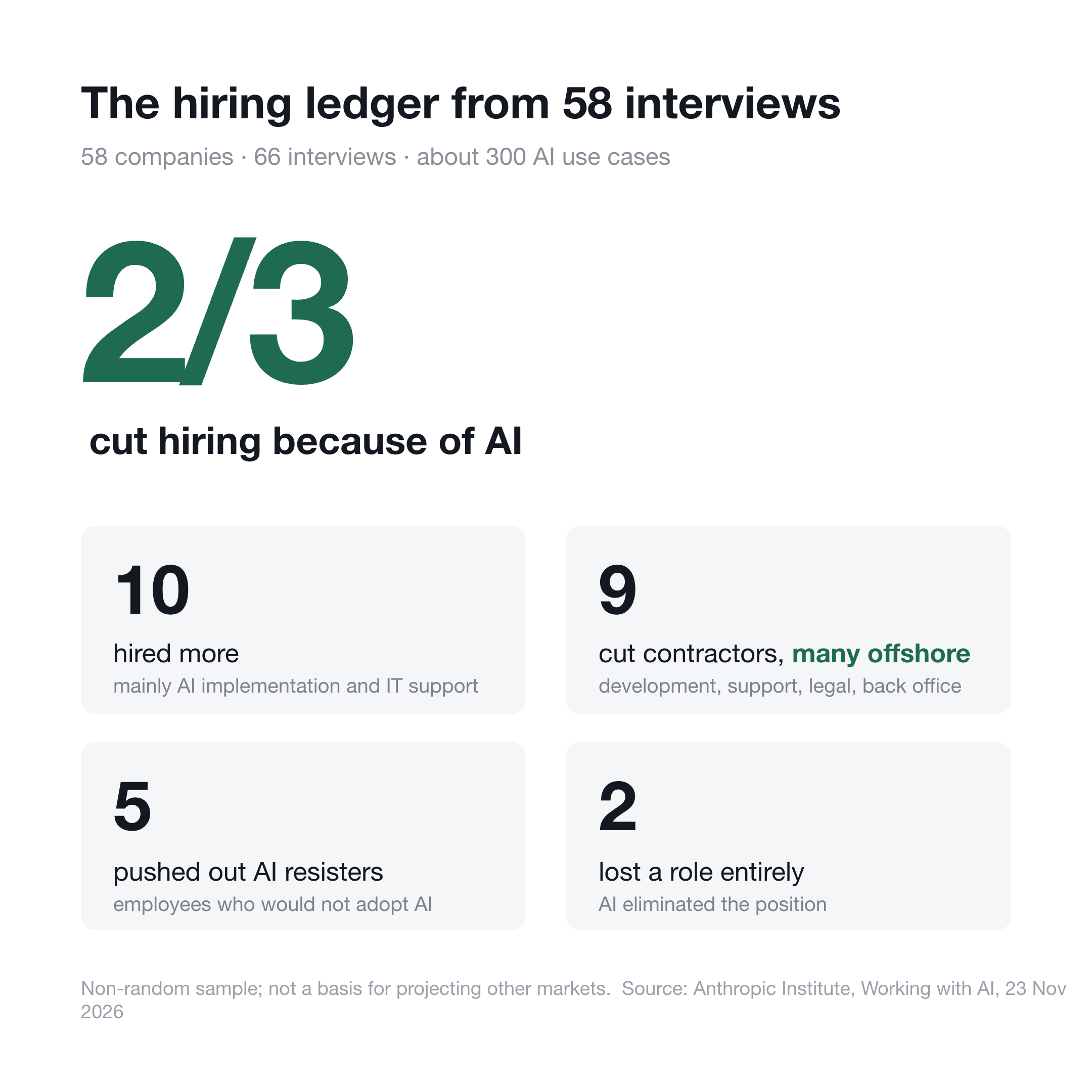
Source: Anthropic Institute, Working with AI, 23 November 2026. Non-random sample; not a basis for projecting the Chinese market.
The contracting layer shows it most clearly. Many of the nine companies had already moved that work offshore. One financial company cut well over 100 offshore data and developer contractors. A software company said that after AI-based contract review went live, its "legal bill has just completely disappeared." A fintech replaced its offshore customer service contracts with AI agents, and its customer service managers now review transcripts and edit prompts, knowledge graphs and operating procedures. Another company's document review agent cut the number of reviewers it had planned to hire this year by more than 90%.
The report is direct about why: outsourced work built from modular tasks — self-contained pieces that can be handed off separately, often without high quality expectations — is the most vulnerable to replacement. It flags this as a possible early warning of job disruption in the international business services industry.
The gate on hiring is changing too. In April 2025, Shopify's CEO circulated an internal memo requiring teams to explain why they could not accomplish a goal with AI before requesting more headcount. That matches the report's observation: what AI changes first is often not who leaves, but the justification required to add a role.
3. Local Efficiency Is Not Organizational Efficiency
Imagine an engineer who uses AI to compress five days of development into one. If requirements still take three days to confirm, testing approval five days, and cross-functional coordination a week, the product may ship not a single day earlier.
This is the report's second core finding: the bottleneck is not the model, it is the process. Nearly every constraint interviewees described sat inside the organization — too much AI-generated content for experts to review in time; wide variation in employee adoption; fragmented data without business context; mismatched speed between upstream and downstream; and unclear ownership of decisions.
A manufacturing example is telling: an engineer used AI to translate product text into ten languages, but the company had nobody who could answer the phone in those languages. The feature was switched off and never shipped. The technical capability was there; the organizational capability was not.
Google's DORA team found the same direction quantitatively in 2024: a 25% increase in AI adoption was associated with higher individual productivity, flow and job satisfaction, but with delivery throughput down around 1.5% and delivery stability down around 7.2%. Individuals write faster; the delivery system does not necessarily move faster, and may become less stable.
For Chinese companies, this lands on specific interfaces: once R&D accelerates, can registration and certification, procurement, production validation and commercialization keep pace? Once sales can produce technical proposals faster, does engineering delivery have the people to match? Once headquarters can set overseas strategy faster, can the local organization execute it? If any one link cannot absorb the speed, the gain stops inside the department that produced it.
4. The Division of Labour Is Shifting: From a Step to a Chain
Three law firms in the report illustrate this better than any framework.
The first automated its mailroom: scanned PDFs arrived in an inbox, a clerk opened each one, skimmed it, saved as, renamed it and filed it, at five minutes per letter. A senior developer watched the process once and, within a month, built a system that eventually collapsed into two API calls. Efficiency improved clearly — and so did the risk to those roles.
The second wanted to build "a second brain" for the firm and stalled across the board: demand letters full of excess em dashes and errors; attorneys' self-built apps hitting menus and buttons that did not exist; concerns about confidentiality; and a few power users firing seven-page instructions at the IT team. The gains never materialized, and neither did any change to roles.
The third adopted early but took a third path. After an AI timekeeping system went live, IT staff whose work was partly automated moved into building secure infrastructure to host apps. Attorneys no longer needed to write first drafts — but, as one put it, without writing, how does a junior know whether a draft is good or bad? So the firm paired associates with senior attorneys to mark up and edit AI drafts together. Nobody was laid off.
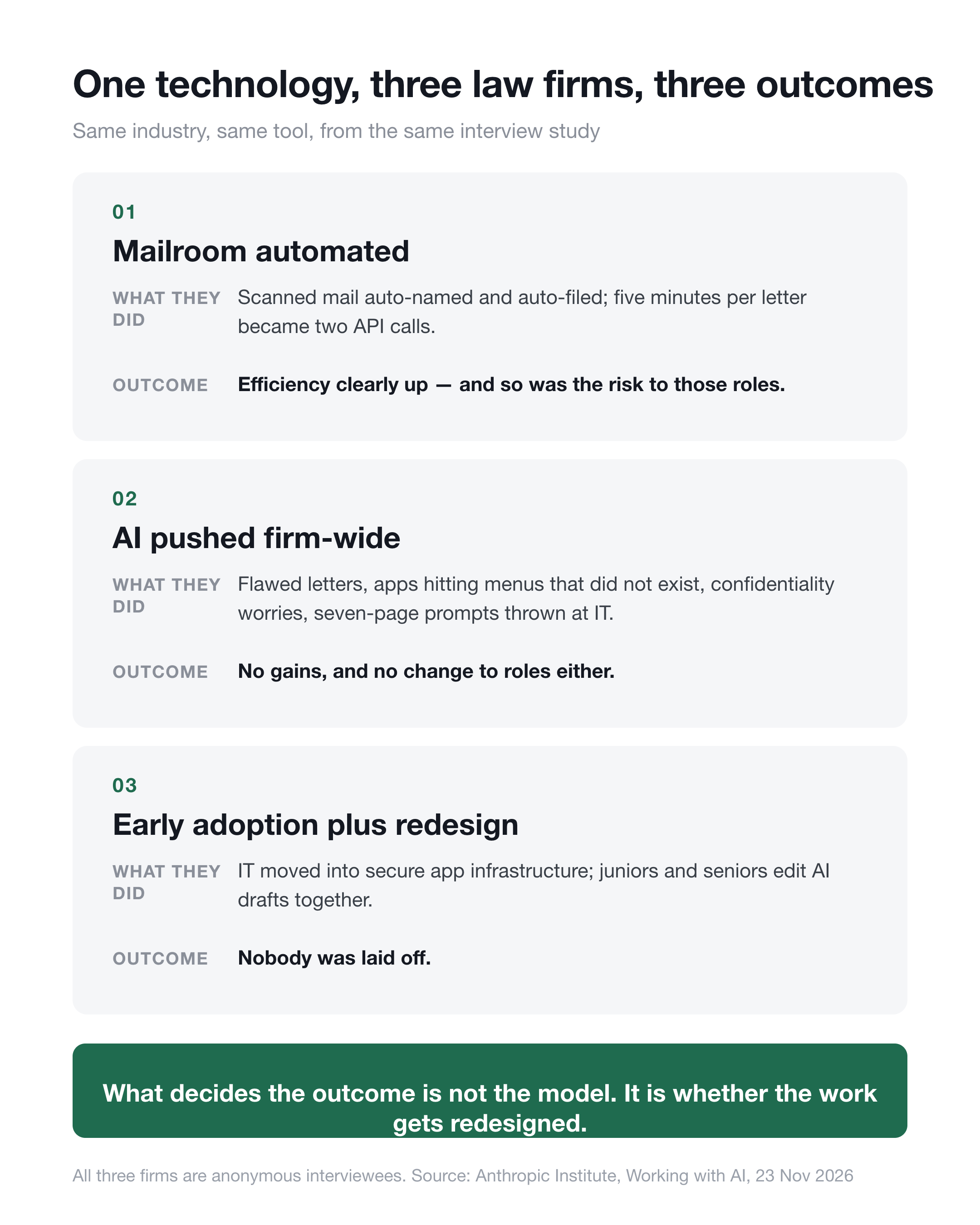
All three firms are anonymous interviewees in the report. Source: Anthropic Institute, Working with AI.
The third firm's approach is the category the report rates highest: broadening roles. As one interviewee put it, "Two people plus Claude is the most amazing thing — if two people agree on something, just ship it." Some companies merged lead sourcing, account executive and customer success into a single role owning the whole customer lifecycle; one collapsed designer, product manager, engineer, QA and even infrastructure into one role.
The reasoning is straightforward. Once production speeds up, cross-functional alignment becomes the slowest link, and every handoff loses a layer of context. Handing the whole chain to one person or a small team removes coordination cost and veto points.
Broadening roles has a welcome side effect: experts have less reason to fear replacement. In the report, one engineer automated alert response, then spent two months reading every conversation transcript, tuning prompts, repairing integrations and supplying missing documentation; six months in, he still sampled transcripts every two weeks. The system grew into a company-wide Slack agent, then into an agent that keeps skills and context current on everyone's laptop. The role did not disappear; it became the owner of the system.
The boundary matters too. In medical devices, financial services, automotive and aerospace, the necessary expert review, segregation of duties and independent oversight cannot be dropped simply because one person can now do the whole task. What gets merged is the coordination layer, not the control layer.
5. Bottlenecks Move, and People Must Move With Them
The sharpest line in the report comes from an executive: "The closer you are to the money, the harder it is for models to excel in that job."
Coding speeds up; code review, sales and strategic decisions cannot keep pace. One engineering leader's response was that "code's no longer the problem — let's put time in user experience testing, let's put time in requirements gathering." A CTO observed that the model "is a terrible product manager," and that deciding which features matter still depends on human taste.
Hence a third type of move: relocating people toward the bottleneck. Project managers at a construction company used to call each site every morning, assemble notes and write a daily report for the customer; now an agent pings the crews, synthesizes responses and drafts the report, and the project managers have their mornings back for customer conversations. A consulting firm moved consultants from reconciling standards documents to person-to-person advisory work. One financial services firm redesigned its internship programme so its "sole purpose is to build expertise and domain knowledge for that person."
The same logic applies to knowledge transfer. Toyota deployed an AI system called O-Beya in its powertrain development division, built on past design reports, current regulations and senior engineers' handwritten documents, used by roughly 800 engineers. The point is not replacement but turning the experience of retiring engineers into a "virtual big room" that newcomers can consult — judgement still has to grow in people.
In one sentence: AI has not eliminated professional judgement; it has turned professional judgement into the bottleneck.
6. The Organizational Layer: Skills, Layers, Managers
When tasks are constantly recombined, knowing which position someone holds is no longer enough to judge what value they can create. Some of the largest firms interviewed have begun systematically inventorying employee skills and tracking shifts in labour demand.
That is why the "skills-based organization" has moved from concept to action. In practice it usually means adding a capability layer on top of the existing job-grade system: professional depth, cross-disciplinary range, core professional capability (communication, judgement, decision-making), AI collaboration (task design, output validation, risk recognition), and learning potential. The first four determine what someone can do now; the fifth determines whether they are still in the game in three years.
Some companies are already far along. Unilever launched an internal AI-driven talent marketplace in 2019, where employees register skills and development interests and the platform matches them to cross-functional projects. Schneider Electric launched its internal talent market in late 2018, initially to address departing employees' complaint that internal opportunities were scarce, using AI to match people to roles, short-term projects and mentors. IBM has promoted "new collar" hiring since 2016, assessing candidates on skills rather than degrees, and has dropped four-year degree requirements from more than half of its US positions. Much of the outcome data comes from platform vendors: useful for direction, treated with care as numbers.
Layers deserve separate treatment. Bayer introduced "Dynamic Shared Ownership" in January 2024, replacing a hierarchy of up to 12 layers and annual budgets with self-organizing teams and 90-day cycles; the company reports halving management layers and cutting management positions by roughly two-thirds. The transformation also came with large-scale layoffs and organizational strain, and is not a template to copy wholesale. More instructive is how a Bayer pharmaceuticals executive described the manager's new role: vision-setter, architect, catalyst and coach.
Three points on managers specifically. Much of a manager's week used to go to collecting information, assigning tasks, tracking progress, checking results and reporting upward — precisely what AI absorbs most easily. What remains is judgement and allocation: translating business goals into clear targets, redesigning human-AI workflows, choosing between people, technology and budget, growing the capabilities subordinates will need, converting local efficiency into business results, and owning the quality, safety and compliance of AI applications. None of these six can be outsourced to a model.
Some companies have gone further, to the function level. In late 2024 Moderna combined HR and digital technology into one function, with the former CHRO becoming Chief People and Digital Technology Officer; by her account to the press, the job has shifted from workforce planning to work planning — redesigning teams around what suits people and what suits technology.
For most companies, the safer question is: which layers actually do nothing but gather information, consolidate progress and relay messages? If a system now does that, the value of the layer has to be re-argued — not cut by default.
7. Incentives: Why Would Anyone Help AI Replace Themselves?
One detail in the report is unmistakably real. When partners asked a paralegal how he prompted AI so effectively, his answer was: "That's my secret sauce... respectfully, I do not want to share with anyone."
At the other end sits monitoring. One operations supervisor starts each day reviewing an AI report on the throughput and error rate of every member of his team. An engineering executive put the shift more subtly: "You want to make your work legible to your manager. But nowadays I think you want to make your work legible to the agents your manager uses." He called it a "panopticon effect," and was unsure whether it was good or bad.
Both point to the same question: if sharing more and automating more makes your own job less secure, why cooperate? The report's recommendation is modest — share part of the efficiency gain with employees, improving job quality and removing tedious work, and plan internal redeployment routes in advance. It also concedes that none of this guarantees against job loss, and does not replace a policy response.
Walmart offers a reference point: in September 2025 its CEO said AI would change "almost every job" in the company, while planning to hold its global workforce of about 2.1 million broadly stable over three years as revenue grows, tracking which roles expand, shrink or hold, and creating roles such as "agent developer."
In China, monitoring employee AI usage also has to clear a compliance gate: the Personal Information Protection Law requires disclosure, defined scope and legitimate purpose. Excessive monitoring costs more than trust; it may cost legality.
8. Six Agendas
Compressed into executable moves, the argument comes down to six items.
First, workforce planning shifts from headcount to capability allocation: people, AI and outsourcing costed on one sheet, adjusted as technology and business change, rather than one headcount table a year.
Second, organization design shifts from departmental efficiency to end-to-end flow: find the real bottleneck in the value chain first, then decide which layer or role moves.
Third, roles and grades: explore broader roles, dual professional tracks and sensible grade bands, and reduce layers that exist only because of division of labour.
Fourth, a skills-based organization: build a skills library, qualification standards and a dynamic allocation mechanism, connected to talent review, internal marketplaces and project staffing.
Fifth, talent review and development: identify critical skills, AI collaboration capability and future gaps, and redesign development mechanisms — including the old method of a senior and a junior editing an AI draft together.
Sixth, pay, performance and incentives: reward business value and innovative contribution rather than frequency of AI use, and study gain-sharing where improvement has been verified.
These six should not be six separate HR projects. They should be designed around one question: what will this company create value from in the future. And the owner rarely sits in HR alone — technology supplies tools and infrastructure, the business redesigns the value-creating process, and HR moves roles, talent and incentives.
CRBPO's view is that AI should first be installed inside existing delivery processes, so that the same people can absorb more demand; the headcount and establishment arithmetic should come after that, not before it. Whether the org chart needs redrawing is not answered by a tool list. It is answered by deciding who will be accountable for the new results.
Sources and Method
Primary source: Anthropic Institute, Working with AI, Technical Report, 23 November 2026, by Nathan Wilmers, Maxim Massenkoff and Peter McCrory. Sample: 58 companies, 66 interviews, all Anthropic enterprise customers, non-random; value is largely self-reported by interviewees; extent of organizational change was coded by an automated reviewer on a 0–100 scale.
Third-party cases (Klarna, Shopify, Moderna, Bayer, Toyota, Walmart, Unilever, Schneider Electric, IBM, Google DORA) are drawn from public reporting or company disclosures, used to illustrate management practice, and do not constitute an assessment of those companies. Frameworks and recommendations are our own, not conclusions of the original report.