
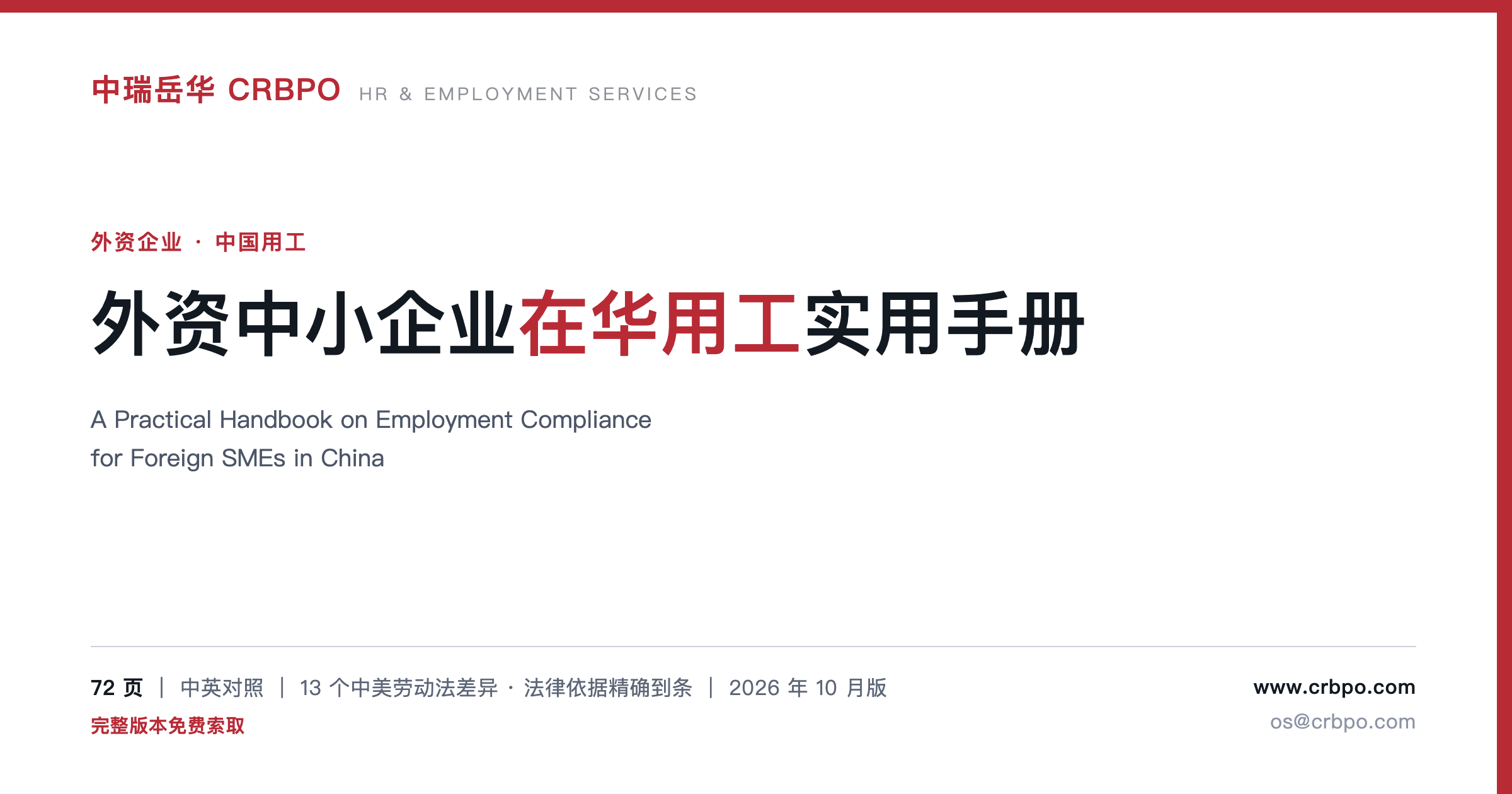
Doing Business in China: 13 US–China Labor Law Differences to Understand First
For a foreign company entering China, one of the most underestimated costs is rarely rent, and rarely headcount — it is labor law.
The US and Chinese employment systems are built on opposite assumptions. Companies that import their home-country habits — verbal agreements, termination at will, no written contracts, no severance — walk straight into labor arbitration in year one, paying in cash and in reputation.
The good news: the differences are knowable. Here are the 13 that matter most before you enter the China market.
1. The legal framework: 50 rulebooks vs. one national system
United States: employment law is largely state law. Each state holds wide latitude over wages, hours, leave, and termination, and the gaps are dramatic — California runs some of the strictest worker protections in the country, while other states stay far more permissive. A company operating nationwide has to master dozens of different rulebooks, which adds up to a serious compliance and HR burden.
China: labor law is set at the national level, through statutes such as the Labor Law and the Labor Contract Law, which cover contracts, wages, working hours, and termination. The framework is more uniform, but national rules tend to stay high-level, with specifics filled in by local regulations. In practice, most disputes are decided by local arbitration committees and courts, so outcomes can still vary by region.
2. Written employment contracts: optional vs. mandatory
United States: written contracts are not required for most jobs. Terms are often established through verbal agreements, offer letters, or company policies — a deliberately flexible arrangement. The cost of that flexibility: when terms are not written down, disputes over what was agreed become far more likely.
China: a written contract is a legal requirement, not a best practice. Fail to sign one within the first month of employment and the employer faces double-wage liability; fail for a full year and the relationship is treated as open-ended. Contract management is a compliance obligation from day one.
3. At-will employment vs. open-ended contracts
United States: the default is at-will employment. Either side can end the relationship at any time for any lawful reason, without liability. At-will is not unlimited — federal and state law still bar wrongful and discriminatory terminations, such as firing someone because of race, color, religion, sex, or national origin under Title VII of the Civil Rights Act.
China: the opposite default applies. After an employee completes two consecutive fixed-term contracts, or meets other statutory conditions, they generally gain the right to an open-ended contract. Employers can only terminate unilaterally for specified legal reasons and through a prescribed process — far heavier and more formal than in the US.
4. Non-compete agreements: a patchwork vs. a national rule
United States: enforceability varies sharply by state. California treats non-competes as largely unenforceable, while Texas and Florida are far more willing to enforce them. Restrictions are tightening, especially for lower-wage workers, so employers increasingly reach for confidentiality and non-solicitation agreements instead.
China: non-competes are recognized and enforceable, but only for senior managers, senior technical staff, and others with access to trade secrets. The post-termination period is capped at two years, and the employer must pay monthly compensation — negotiated up front, never below the local minimum wage. Skip the compensation, and the non-compete can become unenforceable.
5. Wages and overtime
United States: pay is regulated at multiple levels — federal law, state law, industry standards, and employer policy. The FLSA sets the floor for minimum wage and overtime, but states can go higher. The exempt/non-exempt distinction is where it gets complicated: exempt employees are not owed overtime, while non-exempt employees must be paid overtime beyond 40 hours a week.
China: the focus is wage fairness and protecting workers from exploitation. Each region sets its own minimum wage, adjusted periodically. Overtime pay is mandatory, and late or unpaid wages carry penalties. Simpler in structure than the US — but the compliance expectations are strict.
6. Leave and holidays
United States: there is no federal requirement for paid vacation or sick leave. The FMLA provides unpaid leave, but only for employees of larger employers who meet service thresholds. Paid leave is essentially a market benefit, which is why packages vary so widely.
China: leave is codified in national law. Paid annual leave increases with years of service — 5 days for 1–10 years, 10 days for 10–20 years, and 15 days beyond 20 years. On top of that come national public holidays plus marriage, maternity, paternity, and bereavement leave under local rules. For a foreign employer, this is a statutory baseline, not a negotiable perk.
7. The hiring process
United States: hiring is shaped by federal and state anti-discrimination law — the Civil Rights Act, the ADEA, the ADA, and the Equal Pay Act, enforced by the EEOC. Employers must also navigate state rules on background checks, drug testing, credit checks, and salary history.
China: hiring is governed by principles of fairness and non-discrimination under the Labor Law and related rules. Beyond that, the practical emphasis is on getting the foundations right from day one — a signed contract, social insurance registration, and other statutory obligations.
8. Discrimination and harassment
United States: the framework is broad and multi-layered. Federal statutes — the Civil Rights Act, ADEA, ADA, and the Genetic Information Nondiscrimination Act — provide wide protection, and the EEOC actively enforces them. Several states mandate anti-harassment training.
China: anti-discrimination law prohibits discrimination based on ethnicity, race, gender, and similar grounds, and provisions of the Civil Code require employers to actively prevent workplace sexual harassment. Historically, employees have been less likely to pursue formal claims, with many issues handled internally — but public attention on discrimination and harassment, especially gender-based, has been rising quickly.
9. Social security and benefits
United States: Social Security provides a basic layer of retirement, disability, and survivor benefits, funded by payroll taxes. Health insurance, retirement savings, and paid leave are not federally mandated, which is why benefits packages are such a central part of talent competition.
China: social insurance is comprehensive and mandatory — pension, medical, unemployment, work-injury, and maternity insurance, contributed to by both employer and employee at regionally varying rates — plus a housing fund. Managing these contributions is a core part of payroll, and the regional differences require careful attention.
10. Health and safety
United States: OSHA sets and enforces federal standards for a safe workplace, covering hazardous materials, machine guarding, ergonomics, and air quality. Non-compliance can bring fines and, in serious cases, criminal charges.
China: workplace health and safety is governed by national law and regulation, with enforcement strengthening in recent years. Employers must provide a safe environment, run regular safety training, and supply protective equipment. Following high-profile industrial accidents, the government has tightened rules and enforcement.
11. Data privacy and protection
United States: employment data privacy is regulated by a patchwork of federal and state law, with no single federal privacy statute. HIPAA covers medical information, the FCRA covers consumer reports, and states like California have enacted comprehensive privacy laws such as the CCPA.
China: data privacy is governed by comprehensive national statutes — the Cybersecurity Law and, most importantly, the Personal Information Protection Law (PIPL). These impose strict rules on collecting, storing, processing, and transferring personal data, and — critically for multinationals — tight restrictions on cross-border transfers. This demands early and ongoing attention.
12. Termination and separation
United States: termination rules vary by state, contract, and circumstance. At-will gives employers real latitude, but terminations must not violate anti-discrimination law, contractual terms, or specific protections. Mass layoffs may trigger WARN Act notice requirements. Severance is not federally mandated but is commonly offered.
China: termination is tightly regulated. An employer must follow a prescribed process and point to a valid legal reason — misconduct, mutual agreement, redundancy, a major change in objective circumstances, or incompetence. In most cases the employer must first try reassignment or training, and — except in misconduct cases — must pay severance, typically one month's pay per year of service. Redundancy carries additional procedural requirements, including consulting the union or all employees and reporting to the local labor authority.
13. Resolving labor disputes
United States: the system is built around individual rights and an adversarial process. Employees can seek legal advice, file complaints with agencies like the EEOC, or sue in state or federal court. Employers focus on risk management — preventive policies, training, and detailed records.
China: disputes generally must go through labor arbitration first. Before either side can go to court, the case must be filed with the labor dispute arbitration committee where the employment contract is performed — a mandatory precondition. A party unhappy with the award has 15 days from receiving the written decision to file suit; if neither side does, the award takes legal effect.
The bottom line: two employment philosophies
The differences are not a matter of "more" or "less" regulation — they reflect two different employment philosophies. The US defaults to flexibility and at-will employment, bounded by anti-discrimination law. China defaults to written contracts, open-ended employment, and procedural formality, with strong statutory protections for workers.
For a foreign company entering China, the riskiest move is assuming your home-country playbook still applies. Get the employment foundations right — contracts, social insurance, termination procedure — and you remove the single largest source of avoidable cost and dispute.
The above is an overview. The full Practical Handbook on Employment Compliance for Foreign SMEs in China runs 72 pages, with article-level legal citations, key points, and practical tips for each of the 13 topics, in both Chinese and English.
To request the full handbook, please contact us below.
Disclaimer: This article is for general informational purposes only and does not constitute legal advice. Legal basis current as of October 2026. For specific employment decisions, contract terms, or dispute resolution, please consult a qualified attorney or CRBPO advisor.